Showing posts with label Christianity. Show all posts

Monday, February 24, 2014

Is Reality Secular?

Is Reality Secular?: Testing the Assumptions of Four Global Worldviews (Veritas Books)Is Reality Secular?: Testing the Assumptions of Four Global Worldviews by Mary Poplin
My rating: 4 of 5 stars

Book description: What is the nature of reality?

At the root of our society's deepest political and cultural divisions are the conflicting principles of four global worldviews. While each of us holds to some version of one of these worldviews, we are often unconscious of their differences as well as their underlying assumptions.

Mary Poplin argues that the ultimate test of a worldview, philosophy or ideology is whether it corresponds with reality. Since different perspectives conflict with each other, how do we make sense of the differences? And if a worldview system accurately reflects reality, what implications does that have for our thinking and living?

In this wide-ranging and perceptive study, Poplin examines four major worldviews: naturalism, humanism, pantheism and Judeo-Christian theism. She explores the fundamental assumptions of each, pressing for limitations. Ultimately she puts each perspective to the test, asking, what if this worldview is true?

If reality is secular, that means something for how we orient our lives. But if reality is not best explained by secular perspectives, that would mean something quite different. Consider for yourself what is the fundamental substance of reality.


My review: A fresh read best when the author is surveying and commenting on the various world views. The task of the author is to evaluate the different world views against "reality" to see which is the most consistent with "reality". The conclusion is that Christianity contains all the truth there is in other world views but goes beyond them to more comprehensive truth. The last section of the book explores the implications of Christianity being true. The book is essentially an apologetic for Christianity. But it takes a fresh approach and is engagingly written. If someone wants an intelligent introduction to the major themes of Christian thought preceded by a good survey of major world views (material naturalism, secular humanism, pantheism) then it's worth a read. I didn't agree with everything the author says (I rarely do!) but it's an interesting approach from someone who has lived on both sides of religion. An enjoyable and informative read that will, perhaps, be most appreciated by intelligent Christians.

View all my reviews


Tuesday, September 10, 2013

Joshuanism (book)

Joshuanism: A Path Beyond Christianity by Michael Vito Tosto
My rating: 3 of 5 stars

Book description: In this conversational, theological book, Tosto details a new spiritual approach for knowing God in the 21st century. This new approach is called Joshuanism, an evolved expression of Christianity (though it draws from other sources as well, such as Buddhism, existentialism, psychology, and science), rooted in the same son of God Christianity worships: Jesus. Yet in this case, we are approaching him with a fresh, unencumbered perspective, preferring to call on him by his Hebrew name: Joshua. Thus, Joshuanism.

My review: Michael Vito Tosto wants to start a new movement. By writing this book he has made a start. The new movement is Joshuanism - based on the Hebrew transliteration of the name for Jesus. Joshuanism is intended to be an alternative to Christianity which he considers to have lost its way in fulfilling the teachings of Joshua (Jesus). The author's new movement is intended to appeal to those who are disaffected by Christianity or who perhaps have previously had nothing to do with Christianity, but are attracted by the teachings of Joshua. The reason for using Jesus’ Hebrew name is to avoid all the various negative connotations that are associated with the name “Jesus”.


Joshuanism is structured around some carefully articulated elements: The Ten Tenets of Joshuanism; The Eight Immovables of Joshuanism; and The Joshuanism Creed. There's nothing new in this “new” version of Christianity (for that is essentially what it is). There is nothing offered that has not been suggested in other writings or theologies that have, in some form or other, critiqued some of the negative features of some forms of Christianity. Even the suggestion that Zen meditation be practiced by Joshuans is hardly innovative. What is new is the way the author has synthesised it into his own system. Tosto writes in a conversational style and he is articulate and provocative - particularly for those who haven't heard these ideas before. He has also come up with some contemporary terminology (eg the Extraction for the church; the Table for the gathering together of beleivers) which often make more sense than some of the ancient terminology some Christians stick to. The book is engaging reading and does provide the opportunity for reflection on one’s own beliefs and values in relation to Christianity.

There is, however, some cause for concern. I do not want to review the whole system of thought that makes up Joshuanism. But I would like to reproduce the list of the Eight Immovables of Joshuanism. Here they are:

  1. A belief in God
  2. A belief in the Singular Relationship (The Father, The Son, and the Soul of Godliness)
  3. A decision to view God’s Son as Joshua rather than as Jesus
  4. Acceptance of the Ten Tenets of Joshuanism
  5. Acceptance of the Joshuanism Creed
  6. A decision to gather together with other Joshuans in a definitely Joshuan way
  7. A decision to practice the Five Elements
  8. A decision to read primarily The Joshuan Pages version of the New Testament [a paraphrases Tosto is currently working on]
Notice that these are called the “immovables”. In this context, I assume immovable means non-negotiable. In other words, a belief in the doctrine of the Trinity is non-negotiable. You must decide to view Jesus as Joshua - that's non-negotiable. There is a creed that is non-negotiable. You must decide to practice the Five Elements (spiritual disciplines) - non-negotiable. And you must decide to primarily read Tosto’s paraphrased New Testament - that's non-negotiable.
It always bothers me when people start telling me I must believe certain things and do certain things in order to be included in a group. The irony of this in regard to Joshuanism is that Tosto has taken great and repeated pains to affirm what he calls Diversified Uniformity. This is defined as “a proviso within Joshuanism stating that aside from the Eight Immovables, the Joshuan can hold any theological or zoêological view and still be considered a Joshuan.”

The moment any group starts setting up non-negotiables that determine when you're in or out then, however you might say it, it's no different to any other denomination of Christianity that has existed. Creeds haven't had a good history within Christianity. They've always been used to make judgments on others - despite plans not to use them as such.
Perhaps of most concern is the non-negotiable decision required to primarily read Tosto’s paraphrase of the New Testament. Why this? Why would anyone wish to make what someone reads non-negotiable? Providing even implicit primacy to any one version (or paraphrase in this case) seems to imbue it with an inappropriate authority - particularly when it is the product of one person’s interpretation.

Enough said. There are some elements of Joshuanism that are attractive and reasonable. In fact, the majority of the book is probably a very positive representation of the best of Christianity. It is naive, however, to think that producing yet another system with its own creeds, disciplines and doctrines is going to solve the problems of other similar attempts.
So ... worth a read but, like all ideas, think critically before jumping on board any new bandwagon. Adopt what is good and realise that anything good can also be distorted when human fallibility is part of the equation.

View all my reviews

Friday, September 06, 2013

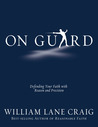
On Guard (book)

On Guard: Defending Your Faith with Reason and PrecisionOn Guard: Defending Your Faith with Reason and Precision by William Lane Craig
My rating: 4 of 5 stars

Book Description: This concise guide is filled with illustrations, sidebars, and memorizable steps to help Christians stand their ground and defend their faith with reason and precision. In his engaging style, Dr. Craig offers four arguments for God’s existence, defends the historicity of Jesus’ personal claims and resurrection, addresses the problem of suffering, and shows why religious relativism doesn’t work. Along the way, he shares his story of following God’s call in his own life.


My Review: William Lane Craig is a very sophisticated apologist for Christianity and this book is a very sophisticated argument first, for the existence of God and, second, for the historicity of Jesus Christ and his resurrection.


The philosophical arguments for the existence of “God” were the most interesting and compelling in the book. Craig is a professional philosopher who studied under John Hick. The topic of his PhD was Liebniz's cosmological argument for the existence of “God”. And his careful and articulate presentation of the argument and refutation of major criticisms is very persuasive and logically coherent. In addition to these arguments, Craig also presents a moral argument for God's existence.


Craig also studied under the NT scholar Wolfhart Pannenberg and he draws on Pannenberg's scholarship in mounting an argument for the historicity of Jesus Christ.


For me, the philosophical arguments were excellent. I didn't enjoy the arguments for Christ's historicity as much - I have more questions about those than the philosophical arguments. And I thought his justification of Christian claims to exclusivity of salvation through Christ could have been better.
William Lane Craig is a frequent target of atheists and there are times I agree with some of the those criticisms. I can't help believing, however, that some of those criticisms are based on a misunderstanding of Craig's arguments.


If you are looking for a clear, articulate defence of (specifically) Christian belief in the existence of God and the historicity of Christ then this book is a good place to start - for believers and non-believers alike.

View all my reviews

Saturday, September 22, 2012

Book Review: Why Men Hate Going to Church (rev ed)

Christianity is not attractive to men at the moment. In fact, men hate going to church, according to David Murrow, the author of Why Men Hate Going to Church. Murrow argues that Christianity has become feminized since the industrial revolution to such an extent that men are leaving in droves or avoiding church like they avoid housework (my example - not his!). The men who do dominate the leadership positions in churches are actually feminized men who feel comfortable with, and demonstrate the characteristics of, women - intimacy, verbal communication, emotions, caring, touching etc.

The entire thesis of this book is premised on the assumption that men and women are completely different in their natures. (The author draws on the popular Men Are from Mars, Women Are from Venus by John Gray.) Murrow believes that most people conceive of Jesus Christ as living out the values ’that come naturally to women.’ The way that church is structured (in most Christian churches) appeals to women because of this belief about Christ and, therefore, men are left out in the cold. Christianity is seen as a "soft" faith and, if men are attracted to Christianity it is because they are ’highly verbal, sensitive, and relational.’ ”Real” men are into power, competition, achievement, practical skills, results, setting goals, etc. All of this is not deliberate, of course. But it's a very real problem.

How do we get men back into the church? Reverse the feminization of Christianity and bring masculine elements back into church worship and life. If the Church is to reverse the declining membership of its congregations (in the West, in particular) it needs to get men back into the pews. Women, it turns out, like churches with lots of men so the focus needs to shift to making the faith more masculine - and the women and children will follow.

Why Men Hate Going to Church is a passionate, fast paced read. It's powerful and persuasive. A lot of the material sounds reasonable and some of Murrow's assertions are backed up with empirical evidence. The idea of “masculinising” aspects of Christian belief and worship is certainly needed? For example, images of Jesus need to become more real than the effeminate versions of much Christian art. And the praise songs that have men singing to Jesus as his lovers definitely need to go!

But I experienced a degree of discomfort as I read this book. Firstly, the differences between men and women seems overly stereotypical. Very little is discussed in the book about the commonalities between men and women. The simplistic distinctions between men and women as described by, for example, John Gray have been criticized as excessively reductionistic and not reflecting how similar men and women are in so many respects. The picture drawn by Murrow seems to "black and white".

Secondly, Murrow's passion and enthusiasm for making his point sometimes borders on sexism. While the feminine is occasionally affirmed it would be easy to infer that the bad aspects of Christian worship and life are the product of female nature. I've only read the book once, but I can't recall any occasion where the author has remotely suggested that “masculine” Christianity may have its problems or any hint at the historical abuse of women by men who have suffered at the hands of men in power. I don't believe this is intentional but Murrow needs to be more careful about this aspect of his views.

In summary, Why Men Hate Going to Church is a passionate plea for the reconsideration of men's needs in our churches. It's a plea also being made outside the church in areas such as education. Men and boys do need healthy masculine role models in the church. Murrow's passion and enthusiasm for the concerns of men is great to see. For me, though, I would have liked to see a more substantial, objective argument presented for rejuvenating Christian worship for all. But then, maybe I'm not a “real” man!

Book details: David Murrow (2011). Why Men Hate Going to Church. Thomas Nelson.

Disclosure of Material Connection: I received this book free from the publisher through the BookSneeze®.com book review bloggers program. I was not required to write a positive review. The opinions I have expressed are my own. I am disclosing this in accordance with the Federal Trade Commission’s 16 CFR, Part 255 “Guides Concerning the Use of Endorsements and Testimonials in Advertising.”


Monday, September 28, 2009

It’s Really All About God

Review by Nathan Brown

In our increasingly pluralistic societies, one of the most urgent questions facing Christianity—and Adventism—is how we relate to those who believe differently. Too often, the traditional approach seems to have been to dismiss these others—anyone and everyone who does not believe as we do. But our increasing interaction with those of other faiths forces us to re-examine these assumptions. Life is often not as black-and-white as we might like it to be.

Samir Selmanovic is one voice who can help Christians—and particularly Adventists—wrestle with these issues. Writing overtly as a Seventh-day Adventist Christian and pastor, his book It’s Really All About God is published by a large mainstream press, Jossey-Bass, but highlights a number of distinctly Adventist contributions to Christian faith and how these also connect beyond Christianity.

Friday, September 25, 2009

Please get rid of your spiritual life…

Guest post by Pastor Sam Neves

Somewhere along the line I think we missed the point. I am constantly reminded of the difference between secular and sacred, worldly and spiritual.

Have you ever wondered why so much energy has been spent labeling parts of our life? I remember being taught that I should develop my academic life, my professional life, my family life and you guessed it, my spiritual life. Over the years I have noticed that if each area of my life was compared to a slice of pizza (can’t help it, my family is Italian), then my spiritual life was just another slice of the pizza.

In practice, this meant having to do my morning worship to feed my spiritual life before I faced the secular world. It meant dedicating one day a week to my spiritual life, the Sabbath, whilst caring for my needs on the rest of the week. It meant having to choose certain music as sacred and ignoring others as secular. Some friendships were spiritual whilst others were worldly. Maybe you can relate. If you are happy with this, please forget this invitation and stop reading now!

If you are not fully satisfied with this formula, please read on...

Tuesday, September 22, 2009

Relevance, Part 3

A couple of things have happened in the last few weeks that inspired me to begin this series on relevance.  This will be the concluding post - but you may find this theme throughout much of what I write (both in the past, and in the future).  When I preach, when I write, when I do just about anything, I ask myself, what is the point?  And this becomes the question I have to ask about God, His Word, and His Church - what is the point?

For me, I've found meaning in God.  The Bible was a little more challenging - but once I moved past the cultural distortions, I have found great relevance in those words.  I'm still wrestling with the Church though.  I'm wondering, what is it that people are trying to do there?

Sunday, September 20, 2009

Exporting Adventism

Overseas not long ago, I had an interesting interaction with an Adventist pastor. I had just finished telling him about a person who had expressed to me a desire to begin keeping Sabbath and to be baptized. I would have expected him to be thrilled with the news, as this individual had been an ongoing ‘project’ for him for some time. To my surprise the pastor appeared disappointed, annoyed, and even a little angry.

Saturday, September 19, 2009

Relevance, Part 2

Annunciation tapestryImage by Lawrence OP via Flickr
When I look around at others, and I try to understand people's motives for church attendance, I am often baffled. I don't really understand why people choose to attend a weekly church service – or get involved at a deeper level. But my not understanding probably says more about me, then it does about the people I'm trying to understand.

Typically, I am not a joiner. I tend to not just go along because everyone else is doing something. As a certified introvert, I tend to prefer my own company over that of others. So, when I see groups of people gathering – for anything, not just church – I am left a little confused as to what their motives, or intentions are.