Showing posts with label Christ. Show all posts

Saturday, September 19, 2009

Relevance, Part 2

Annunciation tapestryImage by Lawrence OP via Flickr
When I look around at others, and I try to understand people's motives for church attendance, I am often baffled. I don't really understand why people choose to attend a weekly church service – or get involved at a deeper level. But my not understanding probably says more about me, then it does about the people I'm trying to understand.

Typically, I am not a joiner. I tend to not just go along because everyone else is doing something. As a certified introvert, I tend to prefer my own company over that of others. So, when I see groups of people gathering – for anything, not just church – I am left a little confused as to what their motives, or intentions are.

Monday, July 06, 2009

A Parable

By Bill Colburn

Once upon a first century time, some followers of Jesus gathered together to pursue a vexing issue. They had been in the crowd that had just been the recipients of another of Jesus’ miracles, this time consisting of vintage red wine, cheese, and manna crackers. Having been raised as meticulous Jews, they argued over whether or not to tithe this unexpected and truly unusual increase, according to the Law of Moses.


They confessed to one another their belief that Jesus truly was the Son of the Living God. They accepted his word that he was greater than the temple. So, to whom should they tithe of this bounty? Should they return God’s portion to the antagonistic priests at Herod’s temple or to Jesus himself? He hadn’t said anything about tithing. What did he expect? Were they being tested? What was right? Would Jesus be offended if they brought back to him a tenth of all he had just given them?

As they continued to challenge one another’s notions about tithing, Jesus came before them. His presence alone, at any other time, would have been supremely cherished. Yet, at this moment, their unresolved question about how to obey the Law thoroughly distracted them.

“Lord, must we and, if so, how should we tithe your blessing?”

“How do you read the scriptures?”, Jesus asked - as he often had.

“We are to return a tithe, one tenth, of all our increase to the temple storehouse“, they said, wondering if it was all still that simple.

“Yes, that is what Moses said. Hmm…but I say to you, no longer are you to return a tithe… Instead, give back to God fully half of all that he has blessed you with.” With that, Jesus departed as mysteriously as he had arrived.

In time, these words of Jesus were spread around the whole community of believers and all began - with no little grumbling and sacrifice - to return fifty percent of all their increase - some figuring net increase, some on the gross - to the temple storehouse. This became the new practice of those who called themselves Christians.

Some time later, after his resurrection, Jesus reappeared to these same disciples. They, of course, were again overjoyed at his presence and delighted to report to him how well his new tithing command had taken hold among most believers - at least in Jerusalem.

To their surprise, Jesus didn‘t commend them at all. “Why did you not listen to me more attentively,“, he said. “Let me be clearer this time. While Moses taught the people to return a tithe of all their increase to the temple, I require that you now return to the temple all that God has given to you as an increase. You are to keep none of it. To him who has an ear, let him hear.”

Many who had been following the way of Jesus, upon hearing this new teaching, claimed that Jesus had gone mad and ceased following any of his teachings.

Saturday, June 20, 2009

Facts and/or Truth

By Bill Colburn


I am repeatedly fascinated by the tension held between 'fact' and 'truth' in the Bible. By this I mean that some things may not be 'factual', but could none-the-less be 'truth'. Why this tickles me is that it runs measurably counter to the way I was raised to think. I used to think that if the bible is truth, then what it says must also be unquestionably factual. If God is perfect then inspiration is perfect and thus everything it says must be fact.

It was in this logic that I recently listened to a preacher/friend interpret the bible story of the Rich Man and Lazarus - using metaphor as literal fact, proving that hell is a place where the unjust are eternally toasted and tormented. When I later mildly challenged his presentation, he responded with the belief that Jesus would not have told a story that wasn't factually accurate, right?

When folks are taught to think about inspiration in this way the result is a concocted interpretation of scripture that conforms to our need to fit God into our finite controllable little boxes rather than entering into a transcendent delight of worshipping the infinite, eternal, Creator God. The scriptures do not present themselves as a book of facts, but as a record of testimonies designed to lift us out of our limited perceptions into the humbling eternal truth of God who is far beyond even our wildest imaginations. Rather than grounding us in manageable temporal realities, it invites us beyond what can be seen and understood - into the realm of faith. The Bible, in many ways, is a projective, a spiritual Rorschach of sorts, eliciting faith through our life-long, daily interactions with it.

A couple of examples from the gospels may suffice to further agitate this notion. John the Baptist was imagined, by some, to have literally been Elijah - returned in the flesh - as Malachi promised. Jesus responded to the queries about his cousin with these words,

"if you are willing to accept it, my cousin John is Elijah".

If we are willing to accept it? Was John or was John not Elijah? At least that is how I once responded to the text. Uncomfortably, in 'fact', John the Baptist was not Elijah. Yet, in 'truth' he was. Don't you just love a 'yes and no' answer?

From another perspective, Jesus tells us that we can be factually guilty, yet simultaneously innocent. In Matthew 12, the disciples of Jesus were accused of breaking the Sabbath. Jesus never denies this as factual. Rather, he pointed the Pharisees back to the scriptures, to David who in 'fact' broke the law, but was in 'truth' innocent.

He then spoke of the priests who in 'fact' broke the Sabbath law, but were also, in 'truth', innocent. Here the facts pointed to guilt, yet the truth pointed to innocence. Why? Well, of course, they used the law lawfully (1 Tim 1:8). The law is not about the law. It was given to lead us to Christ, the compassionate one. Mercy trumps all other purposes for the law.

I used to be a formidably proud, narrow-minded legalist. I perceived scripture as merely two-dimensional. I needed to understand everything on that plane of plain facts. I wanted it all to make sense if it was going to be a part of my life. I spent most of my time trying to make everything manageable within my reality. Such an approach seemed unarguably reasonable. I could only imagine a God who spoke in eternally confirmable facts. I couldn't imagine God making divine accommodations for finite human minds. There wasn't any lisp, as John Calvin once wrote. As a result, there wasn't any room for the unexplainable - no opportunity for the Spirit - thus no transformation in my life.

When we insist on extracting only 'facts' from scripture rather than allowing the Spirit to use the scriptures to lead us to Jesus - the 'Truth' - we get bogged down and 'heavy laden'. There isn't any rest in a penchant for proving everything. Our rest comes in trusting in Christ alone, who is - in fact - the Truth. We need every letter of the law to lead us to Jesus, who gifts us with the Spirit, who, in turn, helps us to live out the spirit of the law - which is to be like Jesus.

Thursday, April 23, 2009

The Kingdom Is Here

Many talk of their desire to have lived when Christ walked the earth. They imagine that if they were present with the master teacher that somehow their lives and their church would be quite different. But, they are mistaken. The things that we long for, the closeness that we imagine, the truths we think we would then understand are more available to us today than ever before.

The Holy Spirit makes it possible for us to be closer to Christ now than when He lived on earth. If we truly believed this, how might it make a difference in how we lived and in how we ‘did church’? It is easy to grow complacent, secretly believing that living the Kingdom of God was for the disciples of long ago.

The truth, however, is that the Holy Spirit makes living a vibrant life and one of restoration possible for every person that desires it. The Holy Spirit knows no limits, no bounds, and no exclusions. Any true seeker may find. As Jesus reminded us, “I stand at the door and knock. If anyone opens the door, I will come in and eat with them.”

We are living in a time of great invitation. The call of Jesus is going out across the world, “If anyone…” Are we open to meeting the needs of a hurting world? Are our arms and hearts open wide to anyone who might need the loving touch, the kind word, or the helping hand?

By studying the life of Christ we are made aware of the importance of the ministry of compassion. Jesus did not engage in the politics of the day, he did not debate theology or preach doctrine, nor did he shut himself away from anyone. Instead, he reached out to whomever had a heartfelt need and poured the love of Heaven through himself out into the world.

If we compare our lives to His, how do we measure up? How much time everyday do you spend in loving service to others for which you do not receive any type of reward or wage? Is there any group of people that you believe are excluded from the ministry of compassion through Christ, any group that you would not be willing to serve? Do politics prejudice you towards others? If someone has a different set of doctrines or doesn’t see eye-to-eye with you, can you still be in loving support of them? How inclusive are you? Where do you draw the line, or do you have a line? Do you think Christ excluded anyone?

These are difficult questions and they strike at the root of our own wounding and sense of scarcity. Imagine with me, a different way of being in the world—a way where we are healed of our sense of separation from God and from one another—a way of being where we do not draw lines of division and square off with one another in debate and conflict. Do you realize how much our current paradigm alienates us from one another and from the world?

It is only through the empowerment of the Holy Spirit that we are able to move past these human limitations of pettiness and division. The Spirit alone is able to heal and restore the image of God within us. Salvation is for everyone. It is we who struggle to embrace the inclusive love of God.

We serve an abundant God. Perhaps we should start with ourselves—reveling in the outrageous grace of a compassionate Savior until we are so delirious with the good news that we our filled with compassion and love for others. The love of God crowds out any sense of superiority or exclusiveness. In fact, God’s love is so immense we will never, ever begin to wrap our minds around it. We can begin by writing a new chapter in our lives and in the life of our church. Let's start living the Kingdom of God now.

Thursday, February 19, 2009

You Are the Light of the World

“You are the light of the world—like a city on a hilltop that cannot be hidden.” Matthew 5:14. These powerful words of Jesus point out to us what discipleship look likes. We are here to bring light into the darkness. To truly be filled with light means that we are filled with the power of an indwelling Christ. Our light comes from the covering of the righteousness of Christ.

If we are then filled with Christ and covered with light we will then be doing the works of Christ in the world. We will be his hands and feet and ministers to those in need. This is what it means to be the light of the world and to be the salt that seasons.

There is a disturbing trend in the church, however, that tends towards exclusiveness. It reminds me of the condition of the church when Jesus came to the world. If you recall, it was a very dark time in the history of our planet and a very dark time in the church. Religion had become a system of forms and elaborate rituals and sacrifices, but it was devoid of the virtues of mercy and of concerns for the good of the people. Only the “pure” were looked upon with favor by the church and the smallest of infractions could find one shunned and excommunicated from the body of believers.

Jesus was highly criticized because of the time he spent hanging out with people the church considered untouchable. They drank alcohol, they were sexually immoral, they had a lot of problems, and they didn’t even attend church. His great heart of love had the audacity to care for everyone, even the immoral Samaritan woman who had been married way too many times.

As a church, are we inclusive or exclusive? Do we shut those in need of the healing power of Christ’s love out because of what they do and how they behave? Do we embrace the power of the Holy Spirit and pray that we will be filled with the miracle working power of God so that we too, like the disciples of old will be able to minister to the healing of those in great need? Or do we live in fear, cloaking ourselves off from the needs of the world?

Do we take care of our planet or do we make excuses for our irresponsibility saying that it will all burn up anyway? Do we believe the majority of people are destined for the flames? Do we call every experience we cannot explain as being from Satan? Do we look for the Christ in people or do we look for the Anti-Christ? Are we a light on a hilltop or has our light been covered by a bushel because we are afraid?

The song “Onward Christian Soldiers” call us, not to be exclusive and ignore the needs of the world—that would be “Onward Christian Chickens”—rather to be a soldier of Christ means that we will work for the good of everyone. We will shine wherever we are and our lives will look a lot like Christ’s.

We can become so fearful of “last day deceptions” that we are useless as far as being a soldier for Christ. I am not speaking of being militant here, I am speaking of being compassionate, available, Spirit-filled, and burdened with the needs of humanity and a dying planet.

Fear is really mistrust of God. Fear separates and insulates us from the needs of those around us. Fear is selfish and is focused on a personal salvation only. When we are busy doing the work of God in the world we will cease to be consumed with our navel-gazing insecurities about our personal salvation. Moses came to an amazing place in his walk with God where he cared more for the good of the people he was trying to help than for his own salvation.

What I long to see is a church where we are more focused on how to make a difference than we are about protecting our fundamental 28. Our beliefs should make us ambassadors of God’s love. They should never insulate us from the needs of others. The world is dying for the light of God’s love. Let’s be a light to the world.

Sunday, November 09, 2008

The Freed Jesus

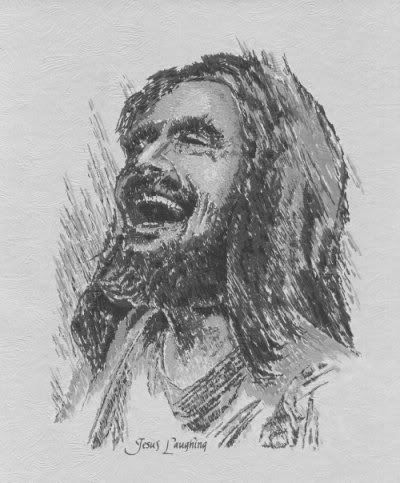
Which of the above depictions of Jesus do you think represents the authentic Jesus? Which one do you think is most consistent with the gospels of the New Testament? On what basis did you make your decision?

The quest for the authentic historical Jesus has been going on since the 18th century. The most (in)famous contemporary group that has engaged in this quest is the Jesus Seminar. The Seminar consists of more than 200 scholars who met regularly to discuss and determine what sayings of Jesus in the gospels were authentic and which represented the construction of the early church. They wanted to discern the historical Jesus from what came to be known as "the Jesus of faith". The scholars of the Jesus Seminar heard papers presented followed, at the end of the sessions, by an opportunity to vote on how authentic they believed certain sayings of Jesus are.

Last week, I had the opportunity to go and hear Dr Greg Jenks, a Fellow of the Jesus Seminar, speak on the topic Behind and Beyond the Jesus Seminar: What It Does and Why It Matters. It was a very enlightening evening and it was great to hear about the work of the Jesus Seminar from one who actually participates in it.

Like many Christians, I don't accept all the claims made by the Jesus Seminar. But I want to share with you one thing that Greg Jenks said as part of his presentation that made a big impact on me. He said that, as a result of modern Jesus scholarship, 'Jesus has escaped Christianity.' He drew on the metaphor of end-user agreements that are used with software. For Jesus, he said, there is 'no end-user agreement that limits Jesus to Christianity'. Jesus is not "owned" by any particular group of people. But often Christians have acted as though Christ belongs to them. And within the splintered denominations of Christianity different "Christ's" have been constructed as the only true Christ.

According to Jenkins, Jesus has broken out of the bounds of Christianity and is being adopted by other religious traditions — Islamic, Buddhist, and so on. All this begs the question: how much have we tried to put Jesus into boxes of our own making? Have we made Jesus in our image? Do we think that God can only bring Jesus to the world through us? And how will we respond to other faith traditions coopting Jesus?

Jesus reigns and he will not be confined. When he died, he died for the whole world (1 John 2:2). Is the Jesus we worship a Jesus who is for all people? Or do we expect others to conform to who we think Jesus is? Maybe we need to learn about Jesus afresh so that we can see him as he wants us to see him.

Technorati Tags: ,