Showing posts with label impressions. Show all posts

Sunday, September 20, 2009

Exporting Adventism

Overseas not long ago, I had an interesting interaction with an Adventist pastor. I had just finished telling him about a person who had expressed to me a desire to begin keeping Sabbath and to be baptized. I would have expected him to be thrilled with the news, as this individual had been an ongoing ‘project’ for him for some time. To my surprise the pastor appeared disappointed, annoyed, and even a little angry.

Tuesday, September 15, 2009

Relevance, Part 1

Twenty-five years ago when I was wrestling with spirituality and religion, I struggled to find meaning.  After dabbling in various religions (e.g. Buddhism, Disco, Scientology, New Age, bowling leagues, and narcissism), I began to re-read the Bible.

My rationale for reading the Bible, wasn't in a search for truth, but rather to expand my rich literary background.  I considered myself well-read, and so, even though I was approaching this from an agnostic's skepticism, I thought it would be good to round out my knowledge.  Instead, I found God.

Sunday, September 13, 2009

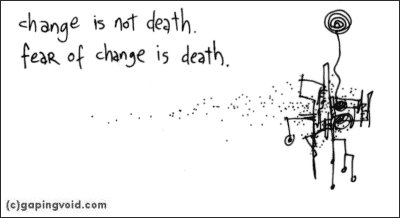
Change

Friday, August 28, 2009

Assimilated

By Bill Colburn

The doc said he had good news and not so good news - depending on my perspective. What?
Several years ago I had to endure a series of unflattering medical tests related to a health issue. The doc suspected something was awry in my head - something folks have been suggesting to me since I was a kid - and strongly suggested an MRI. I was game.

Well, the good news was that the suspected problem, the one that had initiated the need for an MRI, turned out not to exist. However, while in my head, something was discovered they hadn't anticipated. Funny how one thing often unexpectedly leads to another. Is this providence at work?

My brain scan revealed a growth on the very narrow, but quite important 'stalk' that held the pea-sized pituitary gland at the base of my brain. It seemed that this growth was or would begin to compress the passage of some very important substances, hormones to be more specific, essential to the well being of the rest of my body - and, in consequence, my mind.

Ok, doc, I spent four years as a pre-med student. I think I catch the drift of all this. So what is the prognosis?

"Well", he said, " we are going to keep a close eye on this for awhile. We aren’t going to make any interventions - yet. We'll need to take another MRI in a year. Meanwhile, we suspect that you may experience some changes over the next few months. Let‘s just see how this plays out. Don‘t worry."

"Like what kind of changes", I asked, already suspecting his embarrassing answer. "Am I going to become a girl?"

"Well, you may gradually take on more female attributes. Absence of facial hair, alterations in your voice , a new bump here, another symmetrical bump there, etc. If you look at it rightly, this can really be a fun, novel journey - especially as an Adventist pastor in a conference that doesn't hire women as preachers!"

Funny, doc. Where’d he get his medical license from any ways. Smile.

What came to my perennially twisted mind was an episode of Star Trek. I was about to be assimilated by forces beyond my control. All resistance would be futile - unless, of course, there would be some professional outside intervention. But, maybe I'd enjoy this assimilation.

So, what’s this have to do with the church? The fact is, in my opinion, that we have all been unwittingly and unimaginably assimilated, through our nature, into a way of being in this world that shows no mercy. Resistance is futile. The real issue is that we refuse to admit the obvious.


We tend to want to think we are better than others. We exalt our choice of culture, religion, politics, education, and even our race, gender, and age as the evidence that we are not like everyone else. Kind of like the Pharisees and Sadducees of biblical times. Yet all these notions - including Christianity as a religion - are merely superficialities. There are no differences in our human ‘essence‘. Our religious traditions are merely a parody of godliness. Our constructs effectively divert us from the truth, sucking us deeper into denial. We are addicted to that which has cruelly assimilated us. There is no escape.

No amount of healthy eating, working out at the gym, higher educational degrees, political correctness, immaculate pedigree, cultural niceties, or religious profession will bring release. We have all - without exception - been fully assimilated into Babylon, or as Jeremiah so pejoratively stated, we have ‘become women!’ (Jer. 50:37). Sorry ladies. Just quoting the word here.

Our help comes from the Lord, wrote the psalmist (Ps 121). God must take the initiative in our deliverance - we cannot, wrote Paul (Rom 3). We need a new birth, a new nature. We need to hear the very voice of the Father and make our confession like Peter, "You are the Messiah, the Son of the Living God" (Mt 16). This alone, though, is not a one time deliverance. How quickly the ‘rock’ Peter was sucked back into the quicksand 'Borg' of his birth nature.

Within our natural assimilated selves we 'see' only as man sees. Like the Pharisees and Sadducees, we exalt our 'seeing' as divine right. Yet, Jesus called all that evil and adulterous. All our pretensions to glory are self-deceptions, small box thinking, mere variations of the same old Hollywood scripts. Being the depository of the oracles of God has never sufficiently nauseated the 'Borg' to spew us out. We aren’t that special.

Adventism today is again, (still?), wrestling with this reality. We've existed within our bubble of self-righteousness long enough to nauseate ourselves. We are, functionally, no different that the child of Islam, Buddhism, Catholicism, or even atheism. All that we practice and preach and
traditionally cherish is being exposed for what it really has always been - meaningless, even dangerous, non-sense apart from the indwelling power of the living God. We have been deceived by our own cleverness. We remain assimilated. We need help. Divine intervention or all that we are as a community of faith is without purpose.

Only when we confess that we are an evil and adulterous generation can we begin the twelve-steps that lead to genuine serenity. Will we have the humility necessary to grasp the hand of the Almighty and allow him to push the reset button on Adventist Christianity or will we continue to trust in ourselves?

Monday, August 10, 2009

Spiritual Survival Strategies for Adventists

By Bill Colburn

My journey in Adventism has been one that often raises the question among many of my non-Adventist friends, 'why have you remained a member, even a pastor, after the many negative experiences you have had in that church?' It has taken more than an acceptance of the Adventist paradigm - to be sure! The Serenity Prayer has been instrumental.

I remember my first brush with the underbelly of Adventism when, shortly after my baptism in 1976 at 22 years of age, I was confronted by a 'lifer' who had heard that my mom was raised in the Roman Catholic tradition. "How are we to know", he demanded, "that you are not a Jesuit spy just pretending to be one of us?" That dazed me for an extended moment, then I replied, "guess you don't", smiled and left it at that. What an odd fellow, I thought. I was wrong.

I soon began to regularly encounter a curious set of 'adjunctive (and dsyfunctional) fundamental' beliefs that had not been shared with me during my baptismal studies. I frequently got clobbered by such things as: appropriate beach apparel, interpretations of Sabbath keeping such as hiking was OK, but swimming was not, the 'law' against inter-racial marriages or marrying another Christian who wasn't an 'Adventist' Christian or even the 'right kind of Adventist Christian', the sacred hour for sabbath worship being at 11 am only, that I should always wear a suit to church because that is what I would wear to visit the president of the United States, to make gelatin wasn't an ingredient in my foods, to love 'hay stacks' and popcorn, that only Adventist truly knew God, and - well, the list goes on and on and on. These 'other 613' commandments actually formed the reality of Adventism far more than the 27 (er, 28).

Cultural Adventism stood out far more distinctly at the local church than the doctrinal Adventism I had initially imagined 'defined' membership. An early mentor shared with me one significant spiritual survival strategy that has worked: to differentiate between Adventist atheists and Adventist Christians. I had to accept that the church has always had and would always include both. He helped me to see that real Adventism was built on a love for Jesus not on a love for the Adventism folklore. Much that bills itself as Adventism is merely a finicky selection from the buffet of unbiblical 'street' Adventism. To be sure, this is not merely an issue among Adventists!

More painful encounters often and painfully kept challenging my commitment to the church. Usually these had to do with accusations of a sexual nature. It seemed strange to me, as a convert, that many Adventists spent a whole lot of time thinking about sex. Prior to my baptism, non-converts thought a lot about sex as well - but with the desire to enjoy it personally. After my baptism, church members spent an inordinate amount of time thinking about sex, but to make sure no one would ever 'get' what they couldn't have. I could only conclude, after some therapy of course, that if Adventists spent more time having sex they would be a far happier group of people to worship with on Sabbath. I've met a lot of madventists and sadventist, but only the sexually fulfilled could be truly happy Adventists. Maybe we ought to designate every Friday nights as.... Think how pleased the pastor would be to see his whole congregation genuinely smiling on Sabbath mornings rather than wearing a plastic smile while holding a dagger to meet him with at the front door after the sermon.

Some time after becoming an Adventist pastor I was called by my conference president about a complaint stating that I was having an affair. Turned out that an elderly member was riding by a large hotel in a Handi-van and happened to see me open the door for a young woman. No one said anything to me about it until the whole church knew and reported me to the conference. It was rather awkward to address my congregations sexual addiction from the pulpit, but I did. I invited them to all join me at that same hotel once each month - the only times I went there - to participate in the American Cancer Society board meetings with me. They could meet the woman I opened the door for - as she was the president of the local group. I got to keep my job.

Probably far more disturbing has been the necessity to not be fully honest. Seems strange to even express this in these terms, but it is what it is. To function 'healthfully' in the church - intentionally designed for sinners - I've got to be 'unhealthy' by pretending not to be a sinner.

One of our more insidious Adventist 'atheistic' beliefs is that pastors - and members - are supposed to be perfect. This, actually, is translated to mean: "good pastors always agree with what each member believes". To voice a different perspective is to be violently labeled as anti-Christ, demon-possessed, the devil incarnate, and the ever present 'Jesuit spy'. Church members have pejoratively labeled me in many different ways over my years. My favorite is being called a heretic. But, why is it this way? I think it is because we believe we have a 'calling' to be 'faith gate-keepers', rather than faith builders. Gate-keeping always engenders fear. Fear begets dishonesty and pretentiousness, which in turn stifles spiritual growth, which in turn creates 'christian' atheists.

Let me be fair, though. I have many wonderful, spiritually mature Adventist friends. They live above the culture of shame, guilting, and name-calling. They have a deep commitment to the Lord - keeping first things (Jesus) always the best thing, not allowing any foolishness distract them from Him. I feel for them, only in that they find little safety in sharing their love for Jesus openly within the church because of those who define love for God in narrow and angry tones.

Thankfully, maturation in the Spirit is designed to succeed in all places and at all times. So, I remain a member of this church, ceasing all efforts to change what I cannot change, making efforts to change only that which God has asked me to change (me), and continuing to pray that God grants me the wisdom to know the difference.

Wednesday, June 03, 2009

Catalyst West

by Kris Loewen


Discouragement is not supposed to be a word in a pastor’s vocabulary. We are visionaries. Eternal optimism is the name of the game. Our faith outweighs present realities. We envisage the silver lining. Right?

Yet something has gotten in the way of the idealism I had just a few years ago. I feel shame just writing it, but it’s true – and it scares me.

It’s not that my local church is somehow dysfunctional or at war (we’re not). It’s not even that pastoral ministry is different than I expected (it is).

It’s the lack of unity.

Not regarding the Adventist community amongst itself per se – but unity in terms of how Adventists relate with the rest of Christendom. Often when I interact with my Adventist friends about ‘non-Adventists’, I feel a spirit of judgment, cynicism, and a not so subtle ‘us-them’ dynamic (notwithstanding that unfortunate descriptor for Christians who are not Adventists).

A couple of weeks ago, I excitedly told a friend Christine Rohr’s story about her Prison Entrepreneurship Program in Texas (an enterprise in tangible grace: helping convicts learn life skills and stay out of prison after release). The immediate response? “Oh, so is it Adventist?”

Now this isn’t the end of the world and perhaps can be expected on some level. But it is illustrative of a issue many Christians hold in common with Adventists: we tend to think our club is better than everyone else’s; and when theirs is more dynamic, more relevant, and more vibrant, we tend to get cynical, frightened, or defensive rather than grateful for what God is doing. I wonder if somehow we think that if God is working amazing stuff over there with them, then our claim to be exclusively right might be in jeopardy. Do we silently worry, “Have we been passed over? Has God really chosen us?”

So we belittle. We shake our heads in pride, “If only they knew what we knew…then their silly project might mean something”. We identify the true ‘spirit’ behind their work. We push further and further away rather than closer together. This discourages me.


At the end of April, I had the opportunity to attend Catalyst West, a self-proclaimed ‘convergence of next generation leaders’, in Irvine, CA. Beyond the amazing testimonies and challenges of the various speakers (Erwin McManus, Rick Warren, Ravi Zacharias, Alan Hirsch, Guy Kawasaki, and Andy Stanley among others), the most impacting part of the three day week was the unassuming sense of unity and community that pervaded all aspects of the event. “Look at what God is doing here/there/everywhere!” was the theme. The thought of downplaying God’s work all over our country and world because of denominational minutiae did not enter my mind. More than anything, I felt a sense of honor to be alive at this time in earth’s history – when God is profoundly breaking through in new and amazing ways.

In John, 17, Jesus prays for us, those who would come to believe in Him without having physically seen Him. He could have asked God for many things, but He prays only that we would be one – unified with each other and with God. I believe that Catalyst is a spirit-led vehicle for helping that take place. It’s not perfect and there are pieces that get on my nerves (consumerist Christian trade show anyone?), but events like this have the potential to remind us all that we’re in something bigger than our little local congregation or even a fifteen million member organization. We’re part of the Body of Christ – we are his bride – together. As my friend Caleb says, “Jesus is coming back for a bride not a harem.”

The final presentation of the event was by a North Carolinian pastor with a southern drawl named Perry Noble (think ‘Larry the Cable Guy’ with a Greek New Testament). His message? “Don’t quit. Don’t stop. Stay faithful. God has called you – and he is working through you – and he will do great things through you. Stay the course. God will do what he promised”

It was the nail in the coffin for me.

Because he’s right you know. God is at work, his bride is still alive. And our faithfulness and courage in our unique callings is part of something much bigger than denominational squabbles. We are part of a worldwide movement – and if we allow ourselves to be inspired by what God is without a doubt doing everywhere, we will gain the courage to not quit here.

Wednesday, August 20, 2008

The verb 'to be' and identity

Hi everyone.

I want to thank Marcel for the invitation to contribute to this very thought-provoking blog.

____________________

I have great difficulty in saying any sentence that begins "I am ..." (e.g. "I am a teacher"; "I am poor at mathematics"; "I am a Seventh-day Adventist") when it is about my identity. The reason is that the verb 'to be' and its variations (I am, you are, he/she/it is) have enormous potential to be totalising — to become the exclusively defining feature of our identity.

We can hear a similar aversion to this type of language when people who have a disability object to such language as "I am disabled" or "I am dyslexic". Frequently using this type of language about oneself can lead to becoming defined by the characteristic which is part of the phrase.

It is dangerous for others to use this language about another person. If I think of another person in terms of "she is disabled" or "she is aboriginal" we become tempted to stereotype the person and overlook other characteristics that richly define who they are.

It is an interesting exercise to deliberately change language like this about ourselves and others. Changing our language can change our perspective. Consider these examples:

I am a teacher --> One of the things that I do is teach

I am a bad speller --> There are some words I find difficult to spell

I am disabled --> There are some things I am not able to do

I am Australian --> I was born and raised in Australia

Stereotyping is a well known temptation for all of us. We tend to make quick judgments based on one characteristic of a person that becomes the box into which we force them. Deliberately avoiding the verb "to be" when talking about ourselves or others can liberate us from narrow views.

I sometimes wonder whether God was preventing us, as humans, from falling into the same trap when God answered Moses' question about God's name:

13 Then Moses said to God, “If I come to the people of Israel and say to them, ‘The God of your fathers has sent me to you,’ and they ask me, ‘What is his name?’ what shall I say to them?” 14 God said to Moses, “I am who I am.” And he said, “Say this to the people of Israel, ‘I am has sent me to you.’” 15 God also said to Moses, “Say this to the people of Israel, ‘The Lord, the God of your fathers, the God of Abraham, the God of Isaac, and the God of Jacob, has sent me to you.’ This is my name forever, and thus I am to be remembered throughout all generations. Exodus 3:13-15
(ESV)

God resists saying, "I am ..." and filling in the phrase with something specific. God just says, "I am who I am. You can't define me. You can't squeeze me into a box of your own making. You can't pin me down." God is willing to identify Godself as the same God that communicated with Israel's "fathers" — Abraham, Isaac, and Jacob.

Clearly, we do not come anywhere near any equivalence with God. But, as humans made in the image of God, defining ourselves with any sort of categorical box is simplistic, reductionistic, and totalising. I challenge everyone to practice the discipline of avoiding the verb "to be" when talking about self-identity and, instead, celebrate the richness of each one of us that makes it impossible to put us into any box.

Friday, August 31, 2007

A Reality Check For Progressive Adventists

by Alex Bryan

Dan Kimball could not laugh.

And yet he was laughing so violently that his body was heaving in ripples and waves, tears pouring out of his red, swelling eyes, saltwater cascading down his cheeks. How much longer could his tightly closed mouth, reinforced by both hands, which were attached to elbows braced in his lap, hold off the impending outburst … that would send us all into ill-timed delirium?

And so, in order to save himself, Dan left the classroom, leaving behind a half-dozen similarly infected victims (including myself) either to get it together or else. Our in-class, time-passing game of sending silly pictures from laptop to laptop (WiFi is dangerous) was out of hand. The professor couldn’t find out.

Dan Kimball is more than my very funny classmate at George Fox University. He is warm, insightful, deeply spiritual, well-traveled, a key thinker in the emerging church movement, and his newest book They Like Jesus But Not The Church is prophetic. It’s a book for pastors, church leaders, and anyone who thinks seriously and deeply about the challenge of church in our contemporary culture.

His major point is chilling: non-Christians have very negative views of the church (while holding rather positive views of Jesus). Dan’s interviews with non-Christians reveal that these unfortunate perceptions are often based upon non-Christians interaction with (a) highly vocal (often highly weird) Christians who do not represent Christ or the majority of Christians and (b) media portrayals of Christians based upon the worst the church has to offer. They don’t like the church because the “church” they have been exposed to is pretty disgusting!

What’s worse, these non-Christians have had no interaction with the majority of the church: people who are loving, kind, faithful, generous. Why? Because most Christians only relate at a very superficial level (work together) with non-Christians … or they have no relations at all. Christians tend only to make Christian friends.

From personal experience, I am stunned how many pastors, for example, answer “I don’t have any” when I ask them how many non-Christian friends they have. Of those I’ve asked, I can name maybe one Seventh-day Adventist pastor who has a single significant friendship with a non-Christian (or even a non-Adventist).

Last week I asked the inter-denominational pastors’ group I am part of: “What do you think of Seventh-day Adventists?” One response was powerful. “Well, Alex, I had a negative impression until I started interacting with an individual at a hospital in Florida. He is a really great person. We became friends.”

Here’s the point (and a prophetic word for so-called progressive Adventists):

If we allow stereotypes of Adventism to be the face of our faith—images and information defined by the most anti-grace and anti-Christ(like) handbills, billboards, televangelism, and by revisionist and reductionist Adventist history (many today are far less progressive than the founders of this little movement)—then we have abdicated our responsibility to help explain the real Jesus in Adventism.

If we aren’t forming relations(hips) of love with people outside the church, the public relations(hips) will determined by … who?

Progressive (or at least open) Adventists (which, I’m beginning to believe, are the emerging majority in North America), cannot sit back and mourn the negative image of Adventism held by many in the larger culture. We must get out of our homogenized havens, our carefully constructed cocoons, and “be where the people be.” If we aren’t in relationship to people outside the church, we should sit down and shut up. Our progressive musing won’t amount to anything.

As my Australian buddy David would say, “Who are your non-Christian mates?”

This is no laughing matter.