Showing posts with label Questioning. Show all posts

Sunday, November 15, 2009

Meeting the Seventh-day Adventists

Guest Post by Kim L. Ranger

Kim Ranger is a Quaker and member of Grand Rapids Michigan Meeting. She has recently completed a two-year sojourn with Seventh-day Adventists. She is a senior librarian of Arts and Humanities at Grand Valley State University. This article appeared in the September 2009 Friends Journal.

This peace is an abridgment of the article rather than a review. It is important to note that Kim’s comments reflect involvement with a conservative Adventist community. It is impossible to determine from her experience whether or not she would be more or less attracted to an Adventist community in which traditional shibboleths are not so universally agreed-upon.

Five years ago, a spiritual friend and I visited a couple of the Seventh-day Adventist churches, where Adventism piqued my curiosity. I had been a seeker all my life, open to other traditions. As a Liberal Quaker, I was initially appalled by my continuing attraction to the fundamentalist and evangelical Adventism, but eventually I realized that this was a call from God to open up to a different way of believing, worshiping, and living. I began to read about Adventism, study the Bible, participate in Sabbath School each week, and occasionally attended the services for worship.

Monday, September 28, 2009

It’s Really All About God

Review by Nathan Brown

In our increasingly pluralistic societies, one of the most urgent questions facing Christianity—and Adventism—is how we relate to those who believe differently. Too often, the traditional approach seems to have been to dismiss these others—anyone and everyone who does not believe as we do. But our increasing interaction with those of other faiths forces us to re-examine these assumptions. Life is often not as black-and-white as we might like it to be.

Samir Selmanovic is one voice who can help Christians—and particularly Adventists—wrestle with these issues. Writing overtly as a Seventh-day Adventist Christian and pastor, his book It’s Really All About God is published by a large mainstream press, Jossey-Bass, but highlights a number of distinctly Adventist contributions to Christian faith and how these also connect beyond Christianity.

Friday, September 25, 2009

Please get rid of your spiritual life…

Guest post by Pastor Sam Neves

Somewhere along the line I think we missed the point. I am constantly reminded of the difference between secular and sacred, worldly and spiritual.

Have you ever wondered why so much energy has been spent labeling parts of our life? I remember being taught that I should develop my academic life, my professional life, my family life and you guessed it, my spiritual life. Over the years I have noticed that if each area of my life was compared to a slice of pizza (can’t help it, my family is Italian), then my spiritual life was just another slice of the pizza.

In practice, this meant having to do my morning worship to feed my spiritual life before I faced the secular world. It meant dedicating one day a week to my spiritual life, the Sabbath, whilst caring for my needs on the rest of the week. It meant having to choose certain music as sacred and ignoring others as secular. Some friendships were spiritual whilst others were worldly. Maybe you can relate. If you are happy with this, please forget this invitation and stop reading now!

If you are not fully satisfied with this formula, please read on...

Saturday, September 19, 2009

Relevance, Part 2

Annunciation tapestryImage by Lawrence OP via Flickr
When I look around at others, and I try to understand people's motives for church attendance, I am often baffled. I don't really understand why people choose to attend a weekly church service – or get involved at a deeper level. But my not understanding probably says more about me, then it does about the people I'm trying to understand.

Typically, I am not a joiner. I tend to not just go along because everyone else is doing something. As a certified introvert, I tend to prefer my own company over that of others. So, when I see groups of people gathering – for anything, not just church – I am left a little confused as to what their motives, or intentions are.

Tuesday, September 15, 2009

Relevance, Part 1

Twenty-five years ago when I was wrestling with spirituality and religion, I struggled to find meaning.  After dabbling in various religions (e.g. Buddhism, Disco, Scientology, New Age, bowling leagues, and narcissism), I began to re-read the Bible.

My rationale for reading the Bible, wasn't in a search for truth, but rather to expand my rich literary background.  I considered myself well-read, and so, even though I was approaching this from an agnostic's skepticism, I thought it would be good to round out my knowledge.  Instead, I found God.

Sunday, September 13, 2009

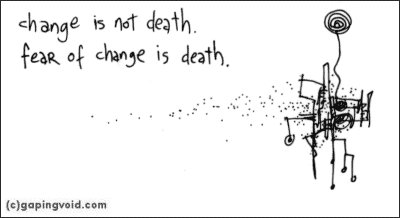
Change

Tuesday, July 28, 2009

Understandings

By Bill Colburn

There are fewer things that make me angry these days, than in earlier years. For instance, how people label me or the things they do to hurt me hardly appear as a blip on my radar anymore. Such things, of course, used to immediately raise my hackles - insanely so. As I have gotten older and somewhat wiser - I hope - I find myself far more able to quickly reframe situations. I consider the 'source', I better understand what drives others to say and do as they do, and - more importantly - I have a picture of Christ that I am passionately trying to emulate by letting him reveal himself through me in patience, kindness, and gentleness - independent of how others treat me.

None of this is to say that I like what happens around me or that I never blow a gasket over issues. I'm still a work in progress. Jesus still sits waiting for his portrait to be painted in me - as someone once wrote. Additionally, I confess, all bets are off if anyone hurts one of my family members. I, without apologies, make no promises to be 'nice' if you hurt one of my family members. I don't even feel a need to work on this attitude. I'll leave apocalyptic, end of time, vengenace to God in all other cases, but this.

I still wrestle, of course, with the way God doesn't intervene today. Our all wise, loving, omnipotent, omniscient Creator God allows the innocent to suffer - regularly. He expects me to intervene with those who are helpless, yet he doesn't. I often can't, he can, yet - again - doesn't. I don't always know that something malicious is happening, so can act. He knows, doesn't act, doesn't inform me so I can act. Big questions here. Why does He allow little ones to be exploited to such a degree that the rest of their lives are full of misery and dysfunction and rejection of belief in a loving higher power?. I don't understand why God doesn't at least warn parents that a child molester is coming for their precious one. Maybe I'm wrong. Maybe it is not that he doesn't, but can't. Yet, I don't buy that either.

In my devotional reading this morning from 2 Peter 2, I read about God intervening to protect his people from their enemies. I found myself reacting angrily - not to the evils of this world - but against God. It was a strange moment. It happened with this text: The Lord knows how to rescue the godly from trial. (v9). I caught myself saying, cynically under my breath, sure, he knows how, but he just doesn't do it. I'm sure this mornings angst on these issues is related to a discussion last evening about the number of church folk who are currently dealing with having been molested as children. It hurts their picture of God. It destroys their current relationships. It all seems so unnecessary - if God had found a way to intervene beyond the cross.

I understand sin. I'm less angry with folks who do 'evil' simply because I understand why what they do is a reaction to what has been done to them. I somewhat understand the etiology of sinful acts and assume that all of us will act sinfully in a myriad of ways simply because we have a sinful nature. I understand that we have no choice except to sin - until we are partakers of the divine nature and actually have a choice not to sin. In other words, sin makes sense - I've been majoring in it for my whole life - so I expect sin. No surprises there. Little anger arises when the expected is realized.

I don't understand righteousness. I'm more angry when the expected is not realized. It confuses me when righteousness seems unrighteous. Yet, to conclude that God is not righteous, that his refusal to use his vast resources to intervene is simply an act of divine selfishness, pre-occupation, and/or a massive cosmic bait and switch scheme - seems equally preposterous and distasteful. Thus, God's inactions according to my expectations remain something I don't understand.

My faith must reside in the ever-so-frustrating tension between understanding and not understanding. Meanwhile, in this world full of the sin we have all come to take for granted, believers cry out, how long o Lord?

Saturday, June 20, 2009

Facts and/or Truth

By Bill Colburn


I am repeatedly fascinated by the tension held between 'fact' and 'truth' in the Bible. By this I mean that some things may not be 'factual', but could none-the-less be 'truth'. Why this tickles me is that it runs measurably counter to the way I was raised to think. I used to think that if the bible is truth, then what it says must also be unquestionably factual. If God is perfect then inspiration is perfect and thus everything it says must be fact.

It was in this logic that I recently listened to a preacher/friend interpret the bible story of the Rich Man and Lazarus - using metaphor as literal fact, proving that hell is a place where the unjust are eternally toasted and tormented. When I later mildly challenged his presentation, he responded with the belief that Jesus would not have told a story that wasn't factually accurate, right?

When folks are taught to think about inspiration in this way the result is a concocted interpretation of scripture that conforms to our need to fit God into our finite controllable little boxes rather than entering into a transcendent delight of worshipping the infinite, eternal, Creator God. The scriptures do not present themselves as a book of facts, but as a record of testimonies designed to lift us out of our limited perceptions into the humbling eternal truth of God who is far beyond even our wildest imaginations. Rather than grounding us in manageable temporal realities, it invites us beyond what can be seen and understood - into the realm of faith. The Bible, in many ways, is a projective, a spiritual Rorschach of sorts, eliciting faith through our life-long, daily interactions with it.

A couple of examples from the gospels may suffice to further agitate this notion. John the Baptist was imagined, by some, to have literally been Elijah - returned in the flesh - as Malachi promised. Jesus responded to the queries about his cousin with these words,

"if you are willing to accept it, my cousin John is Elijah".

If we are willing to accept it? Was John or was John not Elijah? At least that is how I once responded to the text. Uncomfortably, in 'fact', John the Baptist was not Elijah. Yet, in 'truth' he was. Don't you just love a 'yes and no' answer?

From another perspective, Jesus tells us that we can be factually guilty, yet simultaneously innocent. In Matthew 12, the disciples of Jesus were accused of breaking the Sabbath. Jesus never denies this as factual. Rather, he pointed the Pharisees back to the scriptures, to David who in 'fact' broke the law, but was in 'truth' innocent.

He then spoke of the priests who in 'fact' broke the Sabbath law, but were also, in 'truth', innocent. Here the facts pointed to guilt, yet the truth pointed to innocence. Why? Well, of course, they used the law lawfully (1 Tim 1:8). The law is not about the law. It was given to lead us to Christ, the compassionate one. Mercy trumps all other purposes for the law.

I used to be a formidably proud, narrow-minded legalist. I perceived scripture as merely two-dimensional. I needed to understand everything on that plane of plain facts. I wanted it all to make sense if it was going to be a part of my life. I spent most of my time trying to make everything manageable within my reality. Such an approach seemed unarguably reasonable. I could only imagine a God who spoke in eternally confirmable facts. I couldn't imagine God making divine accommodations for finite human minds. There wasn't any lisp, as John Calvin once wrote. As a result, there wasn't any room for the unexplainable - no opportunity for the Spirit - thus no transformation in my life.

When we insist on extracting only 'facts' from scripture rather than allowing the Spirit to use the scriptures to lead us to Jesus - the 'Truth' - we get bogged down and 'heavy laden'. There isn't any rest in a penchant for proving everything. Our rest comes in trusting in Christ alone, who is - in fact - the Truth. We need every letter of the law to lead us to Jesus, who gifts us with the Spirit, who, in turn, helps us to live out the spirit of the law - which is to be like Jesus.


Sunday, May 24, 2009

Questioning

By Bill Colburn


You have probably heard the expression that if something is really true it can withstand intense and repeated scrutiny. Ideally, that ought to be the watch-word of religion. Religion serves us best when it reminds us that the world we live in is not all there is. It invites us to re-imagine everything from the cosmic, eternal perspective. Christianity embraces the vision of an awesome God who ceaselessly inspires awe with joyful anticipation.


Functionally, though, religion - including, unfortunately, Christianity - often imposes itself as a fearful, protector/gate-keeper of the supposed, effectively suppressing all attempts at 'rethink'. Rather than inviting believers to question, it insists on conformity to an already believed set of notions - as if all that can be known of God is already known.

I recently reread Matthew's account (ch. 11) of John the Baptist questioning if Jesus truly was the Messiah. Hoped upon expectations didn't match up with uncomfortable reality of the man. Incredibly, John felt free to question the very integrity of Jesus as Messiah - despite his earlier convictions. Jesus didn't reject the query. In fact, he exalted John, and thus his questioning, before the crowds as one who was not weak as a reed, moved by every breath of wind. John was a great prophet, yet one who so loved God he was unafraid to ask the hard questions. His search for truth would not permit him to suppress his questions or to pretend everything was copacetic, when it wasn't. To refuse to question is to hide from truth - which would have been a denial of the Eternal One.

David Dark's newest book, The Sacredness of Questioning Everything (Zondervan, 2009), presents belief as question. Quoting C.S. Lewis, he suggests that scripture is more often than not used rather than received. When received it is an invitation to pursue the Infinite. When merely used, it becomes a buffet table from which we find support for what we already believe. Here are a couple of thought provoking statements from his book:
Only a twisted, unimaginative mind-set resists awe in favor of self-satisfied certainty.
When religion won't tolerate questions, objections, or differences of opinion and all it can do is threaten excommunication, violence, and hellfire, it has an unfortunate habit of producing some of the most hateful people ever to walk the earth.
My blog entries will attempt to follow this sacred art of questioning - not, though, with anarchical abandon, but with a deep, second naivete love for the God of all who continuously draws us deeper into himself with an everlasting love. In some respects, to quote the title of another book by Peter Rollins, I will pursue the role of the orthodox heretic - as a fully committed wonderer of God. I look forward to hearing your thoughts, in response.